
A home office
that isn't a room

Most of us are not working in a spare bedroom. We are working at the end of a hallway, on half a dining table, in the corner of a living room that has to go back to being a living room at six o’clock. Here is how to make that corner feel deliberate instead of temporary.
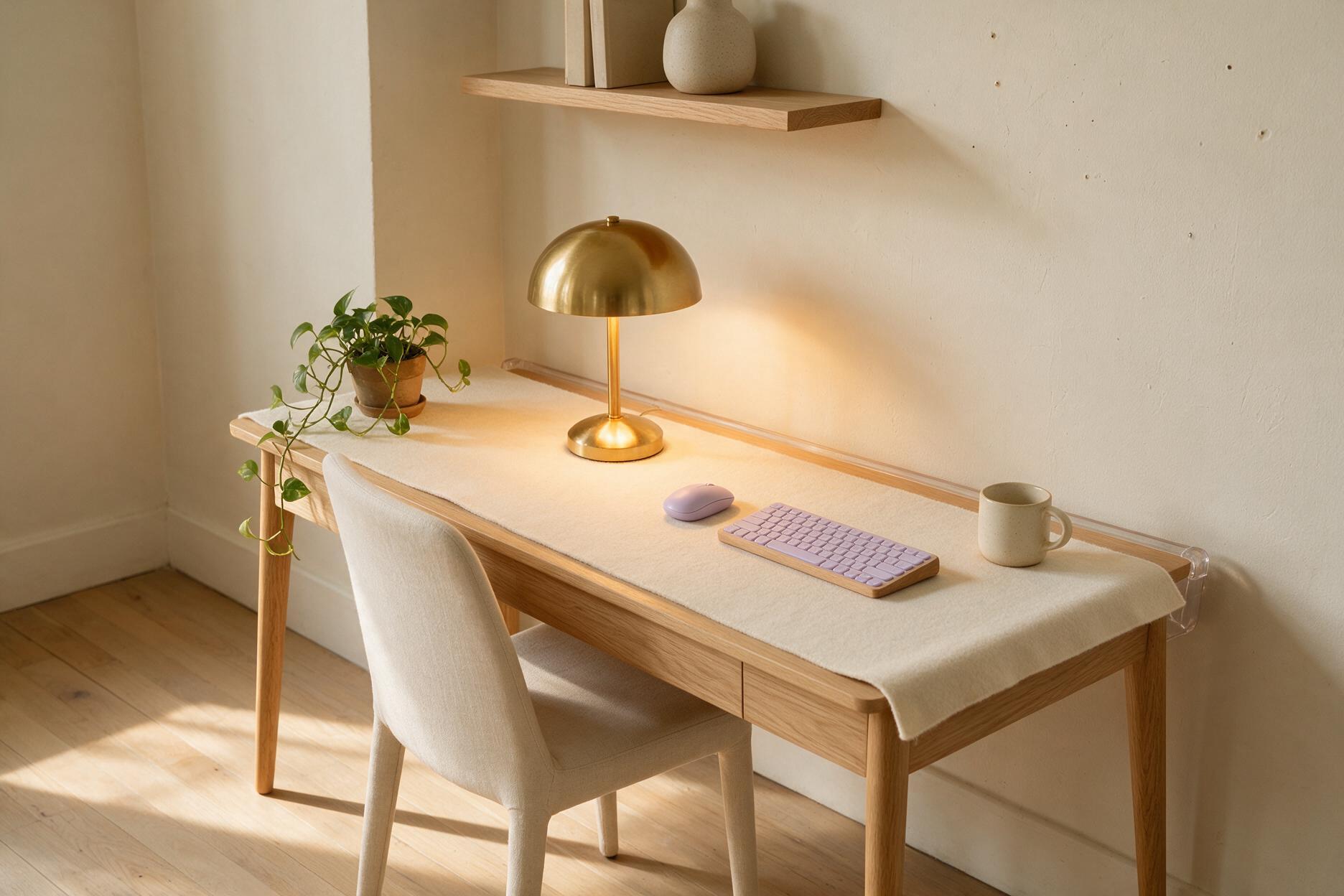
A narrow light oak desk angled into the corner of a living room, with a cream desk mat, a warm brass lamp, a trailing pothos and a single floating shelf above it.

Start here — placement

Seven desk ideas for a room
that isn't an office

You do not need a spare room. You need about four feet of wall that nobody walks through. Pick one of these and stop waiting for the house to change.

  1. A narrow console against a blank wall. Ten to twelve inches deep is enough for a laptop and a lamp, and it reads as furniture when you are not working.
  2. The end of a hallway. Dead space in almost every home, and it usually already has a wall you can hang a shelf on.
  3. A deep windowsill. Free surface, free light. Add a stool and you have a standing-height perch for short tasks.
  4. One shelf at standing height. The cheapest desk there is. A single bracket-mounted board turns a blank wall into a workspace.
  5. The unused half of a dining table. Real if you commit to a tray that lifts the whole setup off in one motion at dinner.
  6. A closet with the doors off. An instant alcove with three walls of privacy, and the door frame gives you a natural edge.
  7. A corner, angled in. The most overlooked one, and the one worth its own section below.

The test for all seven is the same. Can you leave it set up? A desk you have to rebuild every morning is a desk you will stop using by Thursday.

Do this first — it's free

Your desk isn't too small.
It's too full.

Before you buy a single thing, take everything off the desk. All of it, onto the floor or the bed. Then put back only what you actually touched this week.

Most desks get noticeably bigger that same afternoon, and it costs nothing. The pile on the floor sorts itself into three groups without much help from you. Things that belong somewhere else in the house. Things you have not used in a year. And a surprisingly short list of things you genuinely reach for.

That short list is your real setup. Everything you buy after this should be chosen to serve it, which is a much easier shopping trip than trying to fix a cluttered desk with more objects.

The corner

Nine ways to carve an office
out of a corner

A corner is a room if you treat it like one. The trick is giving it edges, because a corner without edges just reads as furniture that got pushed out of the way.
  1. Angle the desk in. Set it across the corner at forty-five degrees rather than flat against one wall. You gain knee room and the setup stops looking like it is hiding.
  2. Float a shelf above it. It doubles your surface without taking any floor, and it pulls your eye up so the corner feels taller.
  3. Run cables down one leg. One leg, not three. A few adhesive clips and every cable disappears into a single line.
  4. Use a rug to draw the edge. This is the one that does the most work. A small rug tells the eye where the room stops and the office starts.
  5. Hang art at seated eye level. Not standing height. You will be looking at it from a chair, and art hung too high makes a corner feel like a hallway.
  6. Light it from the side. A lamp behind you throws your own shadow onto the desk. A lamp beside you at about forty-five degrees does not.
  7. Give it a back. A tall plant, a narrow bookcase, or an open shelf on the exposed side turns two walls into three.
  8. Match the wood, roughly. The desk and one other thing in the corner should agree. Everything else can be neutral.
  9. Leave the corner itself empty. Resist filling the actual angle with a bin or a stack. Empty corners read as intentional.

Styling

Four layers that make
a desk look finished

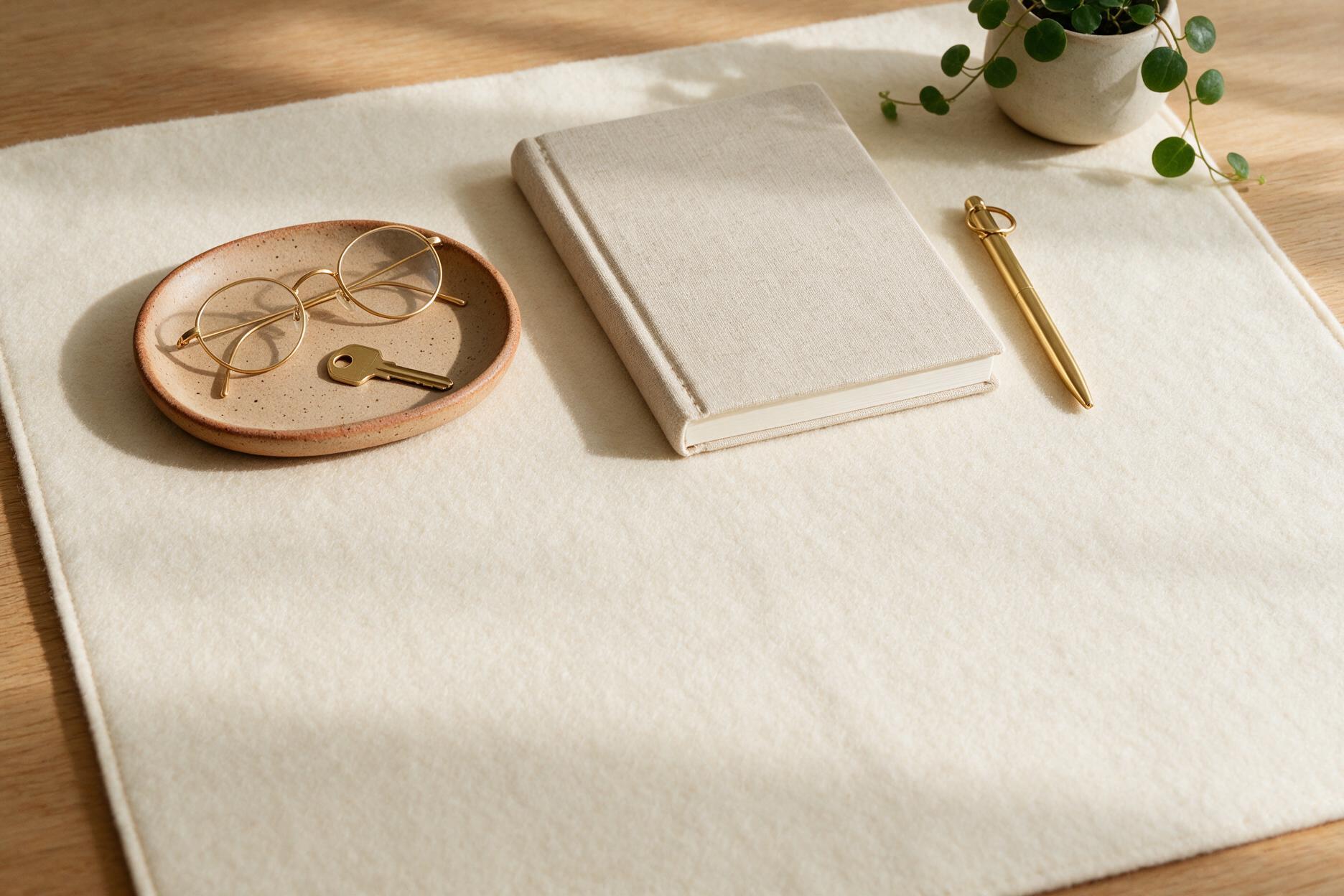
Overhead view of a cream felt desk mat holding a clay tray with glasses and a key, a plain linen notebook, a brass pen and a small trailing plant, with the lower third of the surface left deliberately empty.

Surface, light, texture, negative space. In that order, every time.

  1. Surface. A mat that covers the whole working area, not a small pad floating in the middle. It pulls mismatched wood, plastic and cables together so everything on top reads as one arrangement instead of a pile.
  2. Light. One warm lamp at roughly forty-five degrees to your side. Not the ceiling light, which flattens everything and puts your own shadow where you are trying to work.
  3. Texture. Three materials is plenty. Wood, ceramic and linen is the easiest combination to get right, and it stops a neutral desk from looking like an office supply catalog.
  4. Negative space. This is the layer almost everyone skips, and it is the one doing the most work. Leave a third of the surface genuinely empty and defend it.

If a desk looks unfinished and you cannot say why, it is almost always the fourth layer. Not a missing object. Too many of them.

The short list

Five things on every calm desk

Everything else on a desk is optional. These five are not.

  1. A mat that covers the whole surface. The single biggest visual change for the least money.
  2. One warm lamp instead of the ceiling. Warm meaning around 2700K. It is the difference between a workspace and a waiting room.
  3. Something living. One plant. It does not have to be difficult, and a pothos will forgive almost anything you do to it.
  4. A tray for the homeless things. Keys, glasses, the lip balm, the thing you have not found a drawer for. A shallow dish gives all of it one address.
  5. Empty space you refuse to fill. Decide which part of the desk stays clear and then actually keep it clear. This is a rule, not an object, which is why it is the one people drop.

Color

Warm neutrals beat
cold minimalism

All-white reads like an office you were assigned. Cream, oat and clay read like a room you chose. Same budget, completely different feeling to sit in every day.

The reason is boring and physical. Pure white bounces cool light back at your face and shows every crumb, every cable, every coffee ring. Warm neutrals absorb a little of that light, so the same amount of mess reads as lived-in rather than neglected.

A workable palette for a small space is three warm neutrals and one accent. Cream for the largest surfaces, oat for textiles, clay or wood for the objects you touch, and one color you actually like in a small dose. Soft lavender is mine.

If you already own white things, you do not have to replace them. Put one warm textile down, swap the bulb to 2700K, and most of the coldness goes away for under twenty dollars.

What earns its footprint

Eight work-from-home pieces
you'll actually use

In a small space every object has to justify the room it takes. These eight do.

  1. A chair you can sit in for three hours. The one thing worth spending real money on, because it is the only piece that touches you all day.
  2. A lamp that isn’t the ceiling. Warm bulb, adjustable if possible, positioned to your side.
  3. A mat to define the work zone. On a shared table this is what separates working from eating.
  4. A notepad you don’t have to unlock. Paper is faster than an app for the thought you will lose in twenty seconds.
  5. Headphones that stay on your head. Comfort over sound quality if you have to choose. The best pair is the one you forget you are wearing.
  6. A shallow tray. One address for everything homeless.
  7. A few cable clips. Two dollars, and the single fastest way to make a setup look intentional.
  8. Something that lifts your screen. A stand, a stack of books, anything. Your neck at the end of the day will notice.

Notice what is not on the list. No second monitor, no elaborate storage, no label maker. In a corner setup, more storage usually means more visible stuff.
If you only do one thing

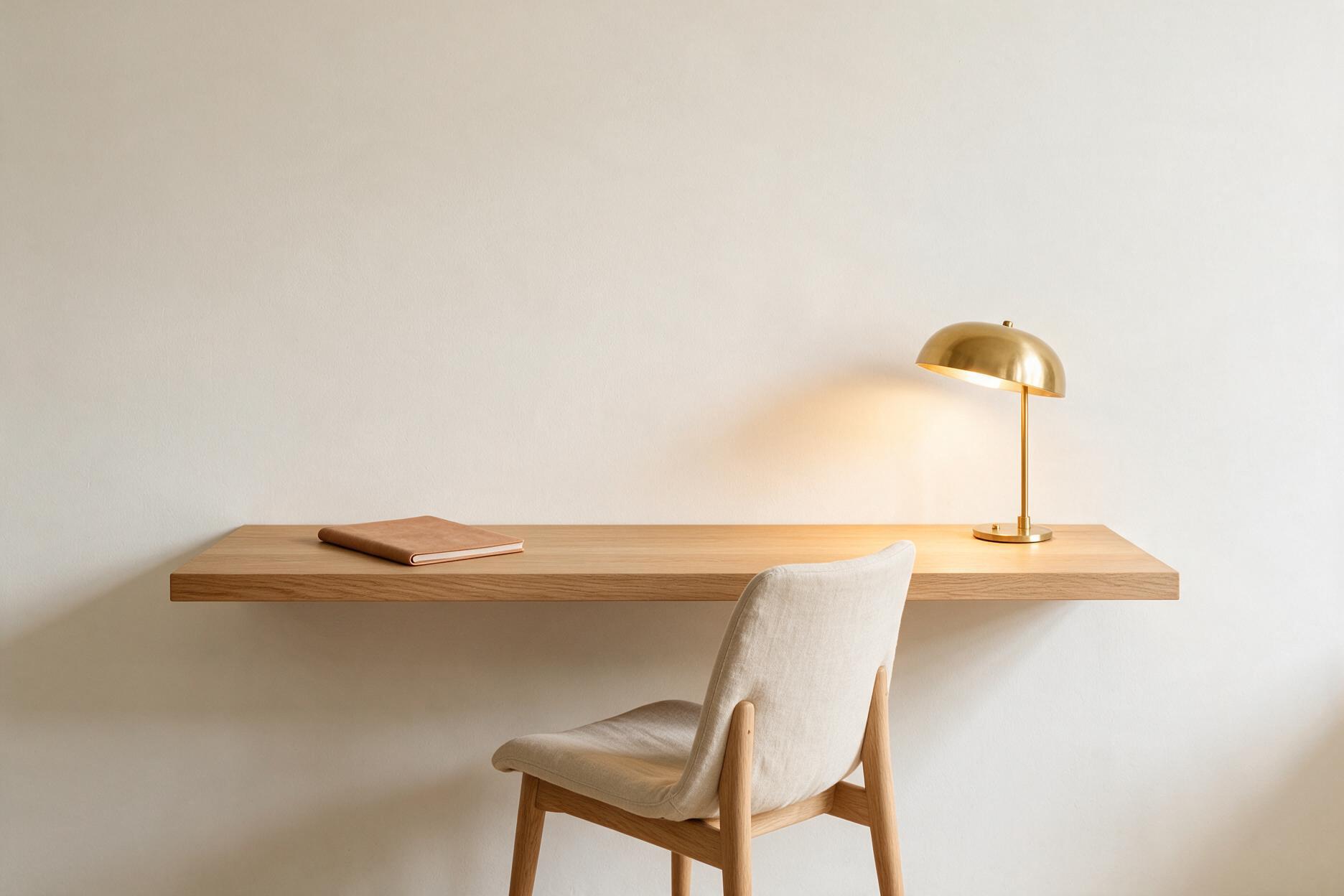
One shelf. One chair.
One good lamp.

A long light oak floating shelf used as a desk against a plain warm white wall, with one pale linen chair tucked under it and one brass lamp switched on.

That’s a home office. Everything after that is preference, not requirement.

Waiting for the full setup is how most people never start. They keep a mental list of what the room needs first, the list gets longer, and a year goes by with the laptop still on the kitchen counter.

So put the shelf up this weekend. Sit in the chair you already own. Buy the lamp. Then work there for two weeks and let the space tell you what it is actually missing, which is almost never what you would have guessed on day one.

Want the specific things?

I keep a short list of the three pieces I would actually buy for a small desk, none of them over $40. It covers the mat, the pad and the keyboard from the sections above.

That page contains affiliate links. As an Amazon Associate I earn from qualifying purchases, at no extra cost to you.

Setting up the desk because
you're starting something?

That was me. The corner was the easy part. If you’re building a little income of your own from that desk, I put the first ninety days into a free Pinterest quick-start checklist. It’s the thing I wish someone had handed me.

And when you’re ready for the whole thing, how I use Pinterest to sell digital products is in Pin Your Way To Free.